What is Node.js? JavaScript on the Server Explained
What Node.js is
Node.js is a free, open-source, and cross-platform JavaScript runtime environment that allows developers to run JavaScript code outside of a web browser.
Key Technical Features
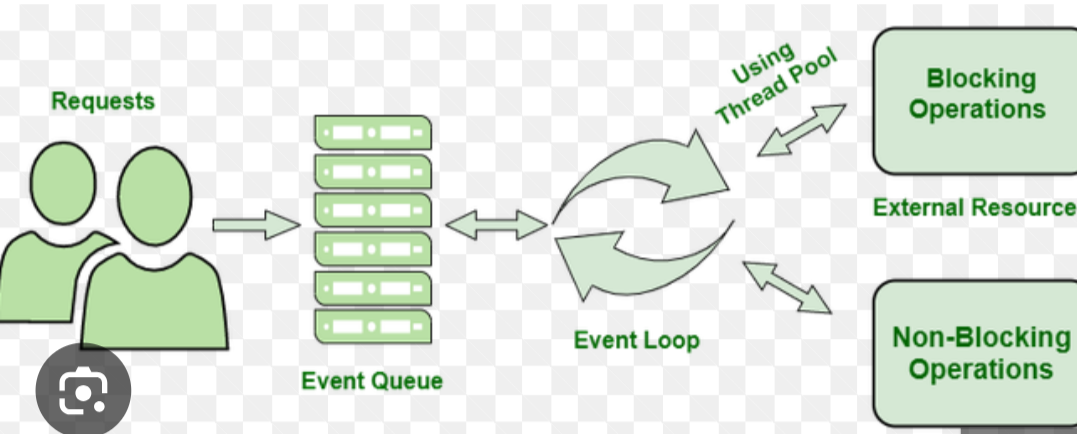
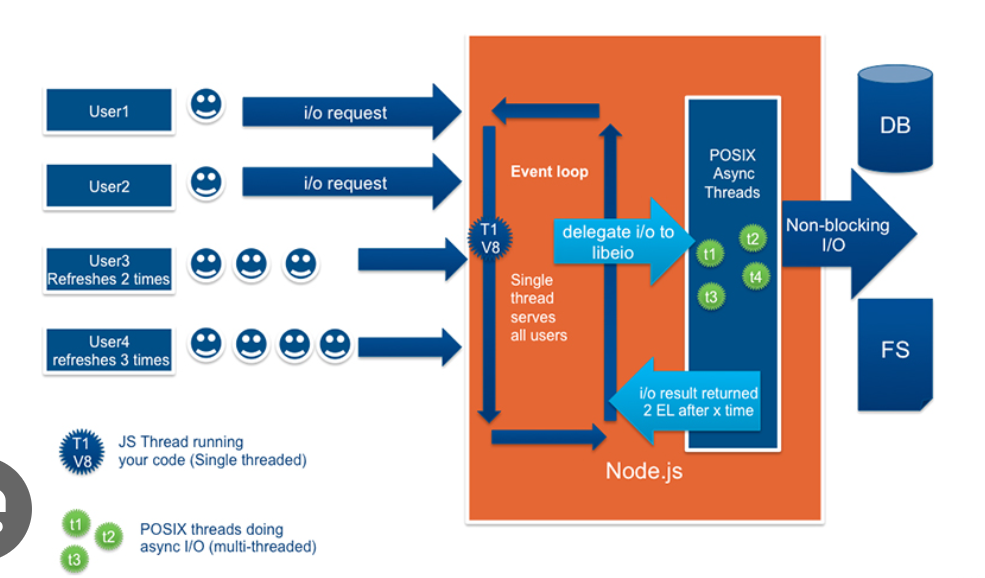
Asynchronous and Non-Blocking: Unlike traditional systems that wait for a task (like reading a file) to finish before moving to the next, Node.js uses an event-driven model to handle multiple connections concurrently without stopping execution.
Single-Threaded Event Loop: It operates on a single main thread but manages high-performance tasks efficiently by offloading I/O operations to the system or a background thread pool.
V8 Engine: It compiles JavaScript directly into machine code, making it exceptionally fast.
Package Ecosystem: It features npm (Node Package Manager), the world's largest ecosystem of open-source libraries, which significantly accelerates development.
Common Use Cases
Back-End Services & APIs: Building fast, scalable RESTful or GraphQL APIs for mobile and web apps.
Real-Time Applications: Powering chat apps, live-streaming services (like Netflix), and collaborative tools.
Microservices: Creating small, independent services that communicate with each other in a larger architecture.
Command-Line Tools: Writing scripts and automation tools for local machine tasks.
Internet of Things (IoT): Managing real-time data from sensors and connected devices.
Core Benefits
Unified Language: Developers can use JavaScript for both the front-end (browser) and back-end (server), simplifying the development process.
High Scalability: Its lightweight architecture makes it ideal for handling thousands of concurrent connections with minimal overhead.
Cross-Platform Support: It runs on Windows, macOS, Linux, and more, allowing code to be reused across different environments.
Why JavaScript was originally browser-only
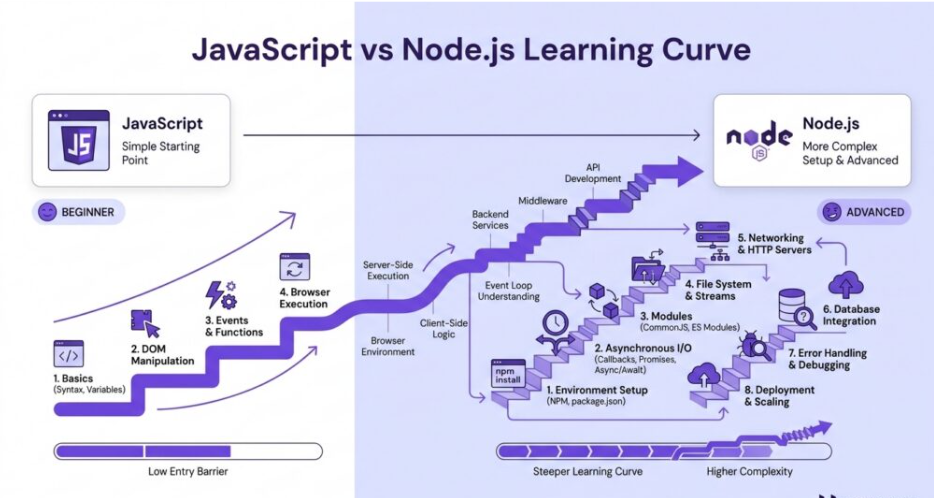
JavaScript was originally browser-only because it was specifically engineered by Netscape in 1995 to solve a single problem: making static web pages interactive. It wasn't meant to be a general-purpose language like C++ or Java; it was a "glue language" designed solely to run inside a browser's sandboxed environment.
Why it stayed in the browser for so long:
Purpose-Built for the DOM: JavaScript was designed to manipulate the Document Object Model (DOM), which only exists in a web browser. Early versions lacked the standard libraries (like file system access or networking) needed to function as a standalone operating system or server language.
Security Sandboxing: To protect users, JavaScript was intentionally restricted to a "sandbox" so it couldn't access a user's local files or hardware. This made it safe for browsers but useless for general system tasks.
Performance Constraints: For its first decade, JavaScript was an interpreted "toy" language and was too slow for heavy server-side processing. It wasn't until Google released the V8 engine in 2008—which compiled JavaScript into fast machine code—that it became powerful enough to run outside the browser.
The "Node.js" Revolution: In 2009, Ryan Dahl used the V8 engine to create Node.js, which finally provided the environment (APIs for files, servers, etc.) necessary for JavaScript to run on a computer's operating system instead of just inside a browser window.
Original Vision vs. Reality
| Aspect | Original Intent (1995) | Modern Reality |
|---|---|---|
| User Base | Designers & non-programmers | Professional full-stack engineers |
| Complexity | Simple scripts (form validation) | Massive, complex web applications |
| Environment | Only Netscape Navigator | Servers, Mobile apps, IoT, & Spacecraft |
How Node.js made JavaScript run on servers
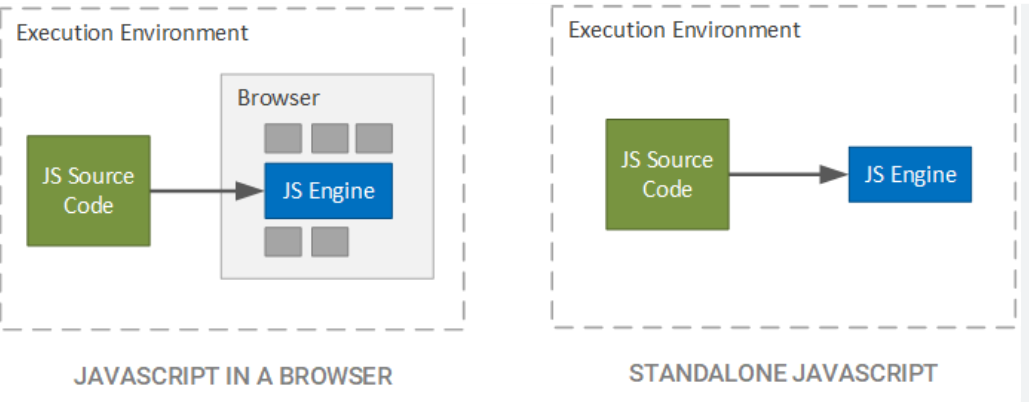
Node.js enabled JavaScript to run on servers by essentially taking the "engine" out of the browser and placing it into a standalone runtime environment. Before Node.js, JavaScript was primarily confined to web browsers for client-side interactivity.
The Core Technology
V8 Engine Integration: Node.js is built on Google Chrome's V8 JavaScript engine, which compiles JavaScript directly into machine code. By wrapping this engine in a C++ layer, Node.js allows JavaScript to interact with a computer's operating system (like the file system) rather than just the browser's Document Object Model (DOM).
Built-in Server Modules: It includes a native
httpmodule that allows developers to create a web server with just a few lines of code. This module handles incoming requests and outgoing responses directly.Event-Driven Architecture: Unlike traditional server environments that create a new "thread" for every request, Node.js uses a single-threaded event loop. This allows it to handle thousands of concurrent connections efficiently without getting bogged down.
Non-Blocking I/O: Node.js processes tasks like database queries or file reading asynchronously. Instead of waiting for a file to finish reading before moving to the next task, it "offloads" the operation and continues executing other code, improving performance for data-intensive applications.
Why This Changed Development
Unified Language Stack: Developers can now use the same language (JavaScript) for both the front-end (browser) and back-end (server). This reduces context switching and allows for massive code reuse.
NPM Ecosystem: Node.js introduced NPM (Node Package Manager), providing access to over a million open-source libraries that simplify complex tasks like authentication, routing, and database management.
Real-Time Capabilities: Its architecture makes it ideal for building real-time applications such as chat apps, live notifications, and collaborative tools using Web Sockets.
V8 engine overview
A V8 engine is an eight-cylinder internal combustion engine configured in two banks of four cylinders, usually set at a 90 degree angle to each other, forming a "V" shape. All eight pistons drive a single crankshaft.
Key Characteristics
Configuration: Typically two banks of four cylinders (a "V"), allowing for a more compact, rigid, and shorter design compared to straight-8 engines.
Power & Smoothness: Known for high power output and smooth operation, with a power stroke occurring every 90 degree of crankshaft rotation.
Balancing: Often uses a "cross-plane" crankshaft to reduce vibrations, although some performance engines use "flat-plane" cranks for higher RPMs.
Applications: Commonly used in heavy-duty trucks, luxury vehicles, and high-performance sports cars.
Primary Types
Cross-plane (Typical): The standard design for passenger vehicles and trucks, providing a distinctive rumble and excellent balance.
Flat-plane (Performance): More common in racing and exotics (e.g., Ferrari, Shelby GT350), allowing faster revving but with higher vibrations.
Pros & Cons
Pros: High power and torque, excellent balance (low vibration), compact for its displacement.
Cons: Higher fuel consumption, higher center of gravity than flat engines, increased weight and complexity.
While traditional V8s are known for large displacement, modern V8s often include advanced technology such as direct fuel injection, cylinder deactivation for better efficiency, and turbocharging/supercharging to maximize performance.
Event-driven architecture idea
An event-driven architecture (EDA) uses events—meaningful state changes like "OrderPlaced" or "TemperatureHigh"—to trigger asynchronous actions via a central broker, offering high scalability, loose coupling, and real-time processing. Common patterns include event sourcing (storing state changes as events), pub-sub, and complex event processing (CEP).
Key EDA Ideas & Use Cases:
Real-time IoT Monitoring: Sensors publish data (e.g., "TempHigh") to an event broker (like Kafka/Confluent). Consuming services (Alerting, Logging, Automated Shutdown) process the data in parallel to detect anomalies.
E-commerce/Finance Workflow: When an order is placed, a "Placed" event triggers multiple microservices independently: payment processing, inventory update, fraud detection, and email notifications.
Audit Trails & Event Sourcing: Instead of storing just the final state, you store all events (e.g.,
Deposited,Withdrawn), allowing you to rebuild system state at any time.AI Agent Orchestration: Using events to trigger multiple, distinct AI agents in a multi-agent system to handle complex, multi-step tasks independently.
Core Components:
Producers: Generate events (e.g., user UI, sensors).
Event Broker: Distributes events (e.g., Confluent/Kafka, RabbitMQ).
Consumers: Act on events (e.g., services).
This model is ideal for building highly responsive, resilient, and extensible systems where components need to operate independently, such as in logistics, finance, or IoT environments.
Real-world use cases of Node.js
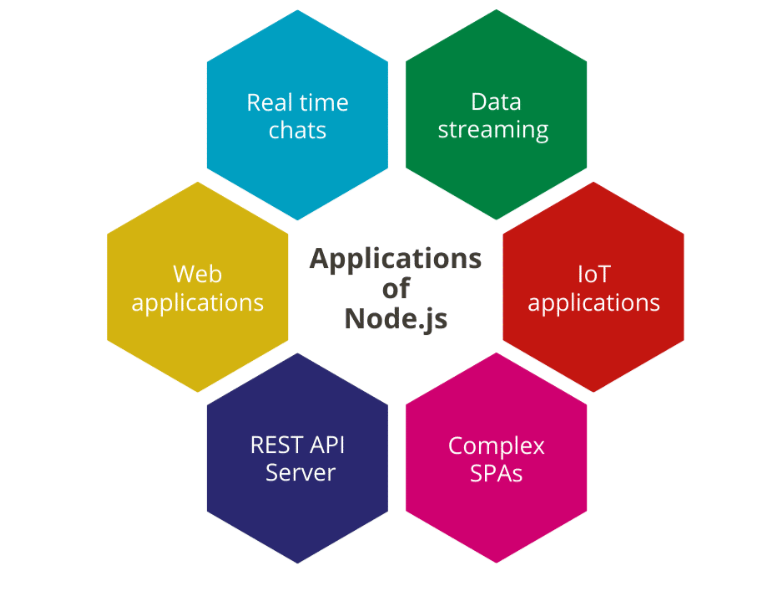
Node.js is widely used for building fast, scalable network applications due to its non-blocking, event-driven architecture. It excels in scenarios where a high volume of concurrent connections and real-time data flow are required.
Primary Real-World Use Cases
Real-Time Chat & Collaboration Tools:
Applications like Slack and Discord use Node.js to handle instant message delivery through technologies like WebSockets.
Trello and Google Docs leverage it for seamless, simultaneous updates across multiple users collaborating on a single project or document.
Streaming Services:
Netflix utilizes Node.js for its low-latency and high-data processing capabilities, which helps deliver content to millions of global users with reduced startup times.
Its native Stream API makes it an ideal choice for building both video and audio streaming platforms.
Microservices Architectures:
- Many large enterprises, such as eBay and PayPal, have moved from monolithic systems to microservices built on Node.js. This allows them to scale individual components of their platform independently.
Internet of Things (IoT):
Node.js is a top choice for IoT because it can manage thousands of simultaneous device connections with a lightweight memory footprint.
CuePath Innovation uses it to track medication usage in real-time through connected pill sensors.
High-Traffic E-commerce:
- Walmart famously transitioned to Node.js to handle massive surges in traffic during events like Black Friday, resulting in significantly improved mobile conversion rates and server efficiency.
Single-Page Applications (SPAs):
- Because Node.js and modern frontend frameworks (like React or Vue) both use JavaScript, developers can build unified full-stack SPAs where the backend and frontend share the same language and data structures.
Famous Companies Using Node.js
| Company | Primary Use Case | Reported Benefit |
|---|---|---|
| Mobile backend scalability | 10x performance boost with fewer servers | |
| Uber | Dispatch system & user APIs | Handles over 15 million trips daily with high performance |
| NASA | Data management | Streamlined data access and reduced access times |
| BBC News | Server-side proxy | Efficiently proxies various third-party services with different response times |